


June 19, 2026
The DELTA project grant: Datacenter Energy & Lifecycle Optimization through Transparent Artificial Intelligence
The rapid growth of digital services, AI applications, and cloud infrastructure is driving a structural increase in data traffic and demand for computing power. In the Netherlands, net data center floor space has expanded by 45% over the past five years, while more than 240 new data centers are expected to become operational across Europe this year alone.
This growth is concentrated in regions such as North Holland, where the proximity of AMS-IX and a highly developed digital infrastructure have created one of Europe’s largest data center hubs. While this development generates significant economic opportunities, it also places increasing pressure on available space, grid capacity, and sustainability objectives.
Data centers are among the largest energy consumers in the digital economy, while societal priorities such as housing development, mobility, and electrification are increasingly constrained by grid congestion. As a result, the need for technological solutions that fundamentally connect digitalization with sustainability has never been greater. The DELTA project addresses this challenge. Through a strategic collaboration between Lucend and the Amsterdam University of Applied Sciences, DELTA is developing an integrated AI platform that enables data centers to optimize both energy consumption and hardware lifecycle performance.
The platform is built around Explainable Artificial Intelligence (XAI) algorithms and component-specific digital twins, supported by advanced technologies including Physics-Informed Neural Networks (PINNs) and Sim2Real transfer learning.
By combining these technologies, DELTA delivers real-time decision support for data center operators, enabling them to maximize energy efficiency, predict potential failures at an early stage, and optimize maintenance strategies. This innovative approach provides greater transparency, reliability, and operational control, helping data centers meet both performance and sustainability goals.
DELTA consists of two modular solutions designed for data center operators:
- Digital Twin Module – Provides real-time insights into energy consumption, system performance, and operational loads, complemented by human-in-the-loop autonomous decision support capabilities.
- Remaining Useful Life (RUL) Module – Uses AI-driven predictive analytics to accurately estimate and extend the remaining lifespan of critical hardware components, reducing downtime and improving asset utilization
Both modules are designed for deployment across hyperscale, colocation, and edge data center environments. Their modular architecture ensures flexibility and scalability, allowing operators to select the capabilities that best align with their operational requirements. Pricing models can be tailored according to data center capacity and scale, making the platform accessible to a broad range of facilities.
By delivering measurable improvements in energy efficiency, operational reliability, and asset longevity, DELTA offers a powerful value proposition for the data center industry. The platform not only supports the sector’s sustainability ambitions but also enables significant operational cost savings and long-term business value.
The DELTA project is supported through the European Regional Development Fund (ERDF/EFRO) and is being developed by two project partners: project lead Lucend (formerly Coolgradient B.V.) and research partner Amsterdam University of Applied Sciences. Together, the partners combine deep industry expertise with leading applied research capabilities to accelerate innovation in sustainable data center operations.
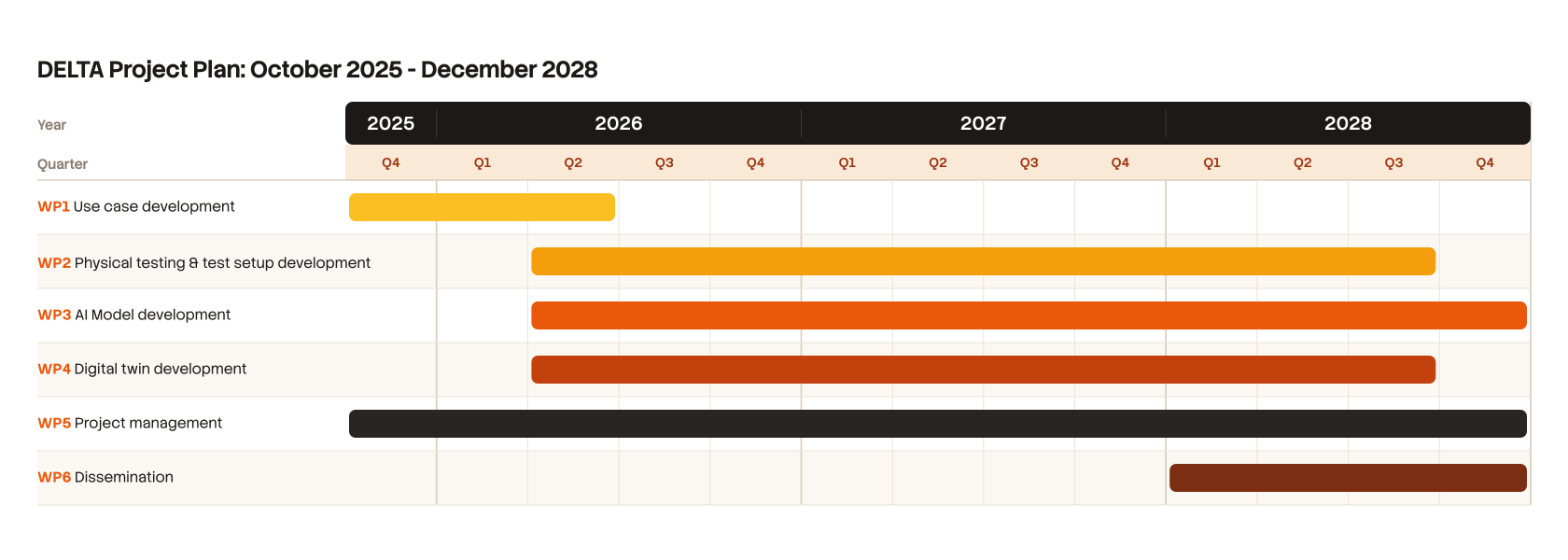
We started the project on October 1st 2025 and the project will run until the end of 2028. We split up the work into six different work packages.
Project Lead Contact:
Daniel van Kooten
daniel@getlucend.com